Author: Joan

Joangineer

I am putting on my engineer’s (hard)hat tomorrow. I have to be an engineer again. I am speaking to 50+ people about why I came Cambridge and why I am a better engineer for it. How to talk about myself in public without sounding like a twat? Interesting problem. I’ve done it before but I’m afraid I will be twatful tomorrow.

It’s surprisingly easy, going back to being an engineer after months of being a social scientist, business student, technology policy scholar, and change agent. Even when I tried to think of non-engineering examples for my ‘script’, I couldn’t. All I came up with was engineering — it was all about construction and industry and water and sludge. I guess… I guess that’s what I am.

I kind of resent it.

You know what I need? I need an engineering role model. I want to talk to engineers that deal with the biggest of big pictures. I want to meet engineers who don’t always go for the technical solution (Don’t kid yourself, renewable energy is a technical solution. Why aren’t you dealing with demand management?). But maybe those that do that aren’t engineers, then.

As you can see, I am a bit crazy tonight.

Here is an example of engineering.


Isn’t it clever? Instead of using a spring to keep the gate shut, we have something even more low-tech. It’s a weight! Attached to a chain! Gravity does it all! How fantabulous.

You know you’re an engineer when you plan a trip to Paris and want to go to the Sewer Museum.

Political Compass Take 2

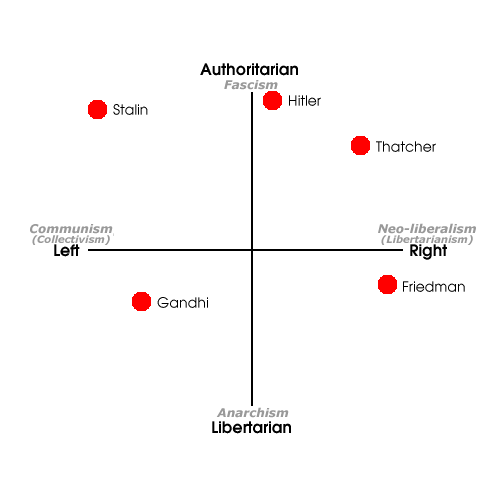
Two and a half years ago, I took the Political Compass test and came out on the Libertarian Left. My scores were:

Economic Left/Right: -2.50
Social Libertarian/Authoritarian: -4.92

Having done this MPhil course, I feel like I have a much deeper understanding of economics, politics, and philosophy. I have just taken the test again. I am still in the Libertarian Left quadrant but check out my scores now!

Economic Left/Right: -7.50
Social Libertarian/Authoritarian: -6.62

Whoa! I’m an angry young Communist Anarchist.

I went for ‘strongly agree’ and ‘strongly disagree’ for most questions. It seems like I have definite opinions now.

You know, I consider myself a pragmatic and polite person. I’m hoping that strength of convictions doesn’t lead to unreasonableness in action. Strong convictions are good, right? As long as I’m not close-minded, I guess.

For comparison, the following graphs come from the website.


I kind of feel sorry for him

From an opinion article in The Age , which observes the tide of public opinion turning against Australia’s Prime Minister, John Howard.

A former Keating government press secretary told a story last week about a recent encounter he had with a Sydney taxi driver. “He was Chinese and I asked him who he would be voting for. He told me that ‘All Chinese people will be voting for Rudd because he has a happy face’.” And, Howard, conversely, has a sad face.

Unscheduled changing of the guard

Here is Joan, paparazzo, in front of Buckingham Palace.


While we were there, there was a changing of the guard. It was a bit of an unexpected treat because the next one wasn’t due until tomorrow at 11:30 AM.

A guardsman appeared in the doorway at the left of the photo and started moving towards the on-duty guardsman stationed in the alcove. He marched very slowly and deliberately.

Stomp.

Stomp.

Stomp.

Stomp.

It went on like this for the three minutes it took for him to get from A to B.

I suppose the unscheduled changeover was finally explained when the travelling guardsman reached the on-duty guardsman and said, ‘Your mother’s on the phone.’

Looming unemployment

There was a knock on the front door and because I was the only one home, I went downstairs to open it.

‘Do you view the future with fear or hope?’ There were two women at my door.

‘Erm.’ I blinked and thought about it. Well, I still go on, don’t I? Despite the war, the injustice, the stupidity and the wastefulness.

‘Basically optimism, I guess.’

The woman who spoke looked a little confused. I guess she had been hoping I’d say ‘fear’ because she went on to read a passage from the bible, assuring me that God was coming take away our suffering.

‘The bible tells us we shouldn’t face the world in fear. The bible gives us hope because God is coming and will solve all these terrible problems we see in the world these days.’

What I thought was, ‘Well, that puts me out of a job.’ What I said was, ‘Okay.’

‘Have you ever thought about the bible?’ she asked.

By this time, you readers might be wondering why I was still talking to the Jehovah’s Witnesses. Essentially, it was a sunny day and I was enjoying the warmth of standing at the doorway. And I had ten minutes before I had to leave the house.

‘No, not really.’ Actually, I’ve thought about the bible before but mostly in a storybook kind of way. I like bible stories but I don’t think that’s what she was getting at.

She gave me ‘The Watchtower’, a thin periodical that looks at different bible passages. I had read one a few months ago, which was about how the bible provides guidance on how to make day-to-day decisions like, ‘What do I wear?’ (nothing too short or sexy) and ‘Should I ask her out?’ (only if you respect her and intend to take it seriously).

That wasn’t the end of the conversation, though, because she asked me what part of China I came from (her husband used to work in Hong Kong). When I said actually, I come from Australia, she and her friend were quite excited because they were from Sydney. We ended up chatting about BBQs and the drought back home.

They promised to come back next week in case I had questions about the pamphlet.

Food as reward

Like many females, I have a love-guilt relationship with food. I have recently become aware of one of my food-related behaviours. I use food as a reward. Whenever I hand in homework, get through a tough day, or even do exercise, I reward myself with food that I would otherwise feel bad about eating.

I don’t know if this behaviour is unhealthy or unhelpful. Maybe I reward myself too much or maybe the concept of ‘food as reward’ reinforces the guilt I feel when I eat food normally.

It leads me to think I need to find alternative ways to reward myself. I read somewhere the suggestion that you could buy a magazine or clothes as a reward. That wouldn’t do it for me, really. I haven’t yet thought of something that I enjoy as much as food.

Yesterday, I did something that made me happy. I had just handed in an essay. It was only 1000 words long but was very, very difficult and frustrating to write. Instead of buying a food reward, I went spent an hour at Borders. I was very happy and didn’t even buy anything.

24 exposures over 24 hours

Some months ago, I had filled in a survey about how I use technology. The researchers then contacted to see if I’d be interested in participating in a ‘learning landscapes’ study.

They gave me a voice recorder, a disposable camera and a notebook. Every 60 to 90 minutes, I got a text message and had to take photos of my surroundings, and record myself describing what I was doing, how I was feeling, and what technologies I was using. If I couldn’t do that, I could jot notes into the notebook. It was a fun day. I ended up going into London to meet people and go to a seminar.

It felt strange taking photos with a film camera, let alone a disposable camera. I couldn’t see if the photo had turned out all right. I couldn’t take as many photos as I am used to. I have used film cameras before but had never felt the constraints of having only 24 exposures per film. That’s because in my film era, I only took photos of the same thing once. In the digital age, I take at least three photos of the same scene using different settings, different perspectives and angles.

Using a disposable camera is no excuse for poor composition. I tried hard to take the best photos I could without being able to adjust aperture, shutter length or film sensitivity. Today, we had a slideshow meeting, where everyone presented their photos and described their day. My photos turned out surprisingly well. The darkest ones must have been thrown out by the developer but otherwise the quality was really quite good.

I think I’ll do this again for fun — buy a disposable camera and practice being hamstrung by low tech and delayed gratification.

Why we’re picky about who we love

I picked up Pride and Prejudice in a second hand bookstore for 75p. It’s my third copy of the book.

This time, my reading of it gave me an insight into a possible reason why, in general, people have increasingly high standards about who they are willing to date, marry or shack up with. I’ve mentioned this before and it seems to be a common enough complaint.

Back in the 1700s and 1800s, women counted themselves lucky if they found a man with enough money to live on and didn’t beat you up. Mr Okay was acceptable (I’m simplifying — the social class was a consideration too). Elizabeth and Jane Bennett were fortunate to find husbands they actually loved and respected but I think most people would have ‘settled’ as Charlotte Lucas did with Mr Collins.

Our list of ‘must haves’ is longer now. Not only are we looking for partners that are basically decent people, but they must also be attractive, successful, intelligent, share our interests, and there’s got to be ‘chemistry’.

Why do we expect to find such perfection in partnership? Why do friends worry about us ‘settling’ for less than we deserve? Why don’t people persevere in okay relationships?

I would like to propose that, alongside female empowerment and the relaxation of social class boundaries, one of the key drivers for our increased fussiness is the invention of the automobile. I heard somewhere that the invention of the car was a revolution in social relations because now, instead of having to marry someone in your village, you could hop over to the next village, or the next, to find a mate.

Because we have more people to choose from, the chances of finding someone compatible in multiple ways has increased. With rising access comes rising expectations.

This leads me to conclude that with the invention of time travel, our demands and expectations will increase yet again. I’ve always thought that if your Mr or Miss Perfect was the wrong age or born before you or exists in the future, then you’d feel pretty cheated. Time travel would solve that.

And then, we would become even fussier when interplanetary and intergalactic space travel is invented. That opens up the whole field of Mr and Miss Perfects that aren’t human. We’d need not settle for any old human ever again.

A worthy cause

You can find the same Big Issue seller outside Sainsbury’s in town almost every day. He keeps up a stream of drawling chatter, spruiking to a constant flow of shoppers who walk by without making eye contact. ‘Big Issue, someone, anyone, buy your Big Issue here, only thirty to go, help out your fellow man, I’ve got thirty more copies then I can go home…’

With his experience, he could work as a spruiker for any retail store.

One weekend, Damjan and I were had popped into Sainsbury’s for fruit. It was getting late and the Big Issue seller’s monologue was still going: ‘Only six more copies, buy your Big Issue, I need money to get drunk, I wish I didn’t but it’s true, buy your Big Issue, six copies to go…’

8 rotten reasons to apply for a PhD

I picked up the New Scientist Graduate Careers Special (28 October 2006) at the Careers Service yesterday. There is a gem of an article by Matthew Killeya (PhD statistics). This is his list of eight rotten reasons to apply for a PhD.

  1. I want three more years of life as a student.
  2. I’ve got nothing better to do.
  3. I fancy my lecturer. (!)
  4. I want to pull students (“Don’t even go there – much, much worse than pulling your lecturer.”)
  5. I want “Doctor” on my credit card (“In fact, most people with a PhD are reluctant to flaunt their title. Imagine somebody introducing themselves as “doctor” in a pub – you’d probably think they were a prat.”
  6. They offered me a place.
  7. I’ll be raking the cash afterwards.
  8. I want to know all the answers. (“…expect your PhD to throw up more questions than answers.”)